Showing posts with label Sheroes. Show all posts

Wednesday, April 11, 2012

Sheroes: Victoria Woodhull & Tennessee Claflin

Sheroes: Victoria Woodhull & Tennessee Claflin
Life: Victoria, September 23, 1838 - June 9, 1927
Tennessee, October 26, 1845 - January 18, 1923
Fame: Victoria- First woman to run for president of the United States.
Tennessee- First woman to open a Wall Street brokerage firm.

Victoria (Claflin) Woodhull and Tennessee Claflin were two daring sisters born 100 years ahead of their time. They were journalists, women suffragists, Wall Street brokers, and spiritualists.

Born into a poor family in Homer, Ohio, their father was a con man, their mother a spiritualist. The sisters grew up working as spiritualists and magnetic healers in their family's traveling medicine show. At age 15, Victoria was married off to Canning Woodhull who turned out to be an alcoholic and womanizer. She continued to work as a clairvoyant with her sister and divorced Woodhull in 1864.

In 1868, Victoria and Tennessee moved together to New York. With money they had saved from their work as spiritualists and the backing of Cornelius Vanderbilt they made history by starting their own Wall Street brokerage firm in 1870. They were the first women ever to work on Wall Street and the sisters soon became known as the Bewitching Brokers.

They made a fortune in the New York Stock Exchange and used their earnings to start the first ever feminist newspaper, Woodhull & Claflin's Weekly, which published over the next six years. It became notorious for publishing controversial opinions on taboo topics, advocating among other things- sex education, free love, women's suffrage, short skirts, spiritualism, vegetarianism, and licensed prostitution. The paper also printed the first English version of Karl Marx's Communist Manifesto on December 20, 1871.


Victoria was the first woman to ever appear before the House Judiciary Committee on January 11, 1871. She gave speech on women suffrage stating that women already had the right to vote, since the 14th and 15th amendments granted the right to all citizens. She argued that all women had to do was use their right. The simple but powerful logic of her argument impressed some committee members.


On May 10, 1872 Victoria was nominated as a candidate for the President of the United States by the newly formed Equal Rights Party at a time when women didn't even have the right to vote.
A few days before the election, both Victoria and Tennessee were arrested for publishing a newspaper article exposing the extramarital affairs of a prominent Protestant minister, Henry Ward Beecher. The scandal cost them their reputation and their fortune.


In 1877 the two sisters moved to England where they lived rich and respectable thereafter- Victoria married a millionaire banker and Tennessee became a nobleman's wife.


Resources: Wikipedia (Victoria & Tennesee), Victoria-Woodhull.comnpr.orgwww.lkwdpl.orgRemarkable American Women, Life Magazine, 1976.

Monday, February 27, 2012

Sheroes: Emily Dickinson

SHERO: Emily Dickinson, poet
LIFE: December 10, 1830 – May 15, 1886
FAME: Regarded as one of America's greatest poets.

Emily Dickinson was one of the greatest poets in American history. She is famous for dressing in all white and becoming a total recluse by her late twenties. She secretly wrote nearly 1800 poems while locked in her room refusing visitor after visitor. Only a few of her poems were published anonymously during her lifetime. It wasn't until after she died that her younger sister, Vinnie discovered her massive collection of hand bound books of poetry.

Her works challenged the existing definitions of poetry. She experimented with expression. Many of her poems contain short lines, typically lack titles and use slant rhyme as well as unconventional capitalization and punctuation. Death and mortality were common themes in her writing. 

"Hope" is the thing with feathers
That perches in the soul
And sings the tune without the words
And never stops at all,

And sweetest in the gale is heard;
And sore must be the storm
That could abash the little bird
That kept so many warm.

I've heard it in the chillest land
And on the strangest sea,
Yet never, in extremity,
It asked a crumb of me.

GROWING UP: Emily Dickinson was born in Amherst, Massachusetts into a well-known family, long established in New England. She grew up in a house called "the Homestead," built by her grandfather in 1813. Her father was strict in her upbringing and believed that his children should be well-educated. Emily was a bright student and an original thinker. 

In 1845 Amherst experienced a religious revival in the community. Emily stood out as an eccentric, when as a young girl, she refused to join the church officially or even call herself a Christian.

After primary school, she attended the Mount Holyoke Female Seminary, where she was able to study a wide range of subjects including both Latin and English literature. Due to ill health, she returned home after only one year.

I'm nobody! Who are you?
Are you nobody, too?
Then there's a pair of us - don't tell!
They'd advertise - you know!

How dreary to be somebody!
How public like a frog
To tell one's name the livelong day
To an admiring bog!

LIFE IN SECLUSION: Around 1850, something changed in her life, and much mystery surrounds what exactly what that change was. Because of her discomfort and shyness in social situations, Emily gradually reduced her social contacts, going out less and less. By her late twenties she lived in almost complete seclusion, locking herself in her room for days at a time, refusing all visitors. Her sister explains this wasn't a sudden decision, but a gradual process that happened over a period of time. 

Despite her reclusive lifestyle, Emily was a prolific letter writer and much of what we know about her life has been learned through her correspondences with a select group of people. Emily died at age 56 of Bright's disease. Her first book of poetry was published in 1890, four years after her death.

Resources: sparknotesbiographyonline.netwikipedia.orgpoets.orgRemarkable American Women, Life Magazine, 1976.

Monday, February 6, 2012

Sheroes: Pearl Buck

SHERO: Pearl Buck, Writer
LIFE: June 26, 1892 – March 6, 1973
FAME: The first American woman to be awarded the Nobel Prize in Literature

Pearl Buck was an American writer who lived and wrote about China. Born in 1892 in Hillsboro, West Virginia, she grew up in Chinkiang, China where her parents were stationed as missionaries. During her time in China (a total of 40 years residency) she experienced life in poor rural areas, and survived the Boxer Rebellion and civil war. 

She began writing in her twenties and published her first novel, East Wind, West Wind, in 1930. In 1931 she published The Good Earth, her best-selling novel about the emergence of modern China. The book won her the Pulitzer Prize in 1932. In 1938, she became the first American woman to be awarded the Nobel Prize in Literature "for her rich and truly epic descriptions of peasant life in China and for her biographical masterpieces." (source)

DID YOU KNOW? The second American woman to receive the Nobel Prize was Toni Morrison in 1993 (61 years later!).

In 1934 Pearl Buck returned to America where she focused on humanitarian efforts, campaigning for minority and women's rights. She spoke out against Japanese-American internment camps during World War II and was a target for surveillance by Senator Joseph McCarthy and the FBI. In 1949 she founded Welcome House, the first international, interracial adoption agency in the world. She also helped to open America's mind and attitude toward mental disabilities by writing The Child Who Never Grew Up about her daughter Carol in 1950.

DID YOU KNOW? In her lifetime, Pearl Buck published over 70 books including fiction, nonfiction and children's books. (Why weren't more of her life and works taught in school?)

Remarkable American Women, Life Magazine, 1976.

Monday, January 23, 2012

Sheroes: Janis Joplin

SHERO: Janis Joplin 
LIFE: January 19, 1943 – October 4, 1970
FAME: Dubbed the first Queen of Rock and Roll.


GROWING UP: Janis grew up listening to blues musicians such as Bessie Smith, Odetta, and Big Mama Thornton in Port Arthur, Texas. She sang in the church choir and was also a painter. Growing up in Texas was a real struggle for her, as she didn't conform to the mold of a typical young woman of the 1950's.


DID YOU KNOW? In 1950 Janis joined Bluebirds, junior Girl Scouts.


LIFE AS A MUSICIAN: In 1966 Janis Joplin moved to San Francisco where she joined the band, Big Brother and the Holding Company. During the summer of 1967- the summer of love- the group had a breakthrough performance in at the Monterey Pop Festival, where Janis belted a version of Big Mama Thornton's, "Ball and Chain" while the world watched in awe. 


"Playing is just about feeling. It isn't necessarily about misery, it isn't about happiness. It's just about letting yourself feel all those things you already have inside of you but are trying to push aside because they don't make for polite conversation or something. But if you just get up there — that's the only reason I can sing. Because I get up there and just let all those things come out." - Janis Joplin


Like most musicians during that time, Janis was a heavy drinker and experimented a lot with drugs. While recording her last album, "Pearl" in October of 1970, she overdosed on heroin in a motel in Los Angeles at the age of 27. 


DID YOU KNOW? Pearl was her nickname known amongst her friends.


LIFE ACCOMPLISHMENTS: Janis paved the way for women in Rock and Roll. In the 1960's, women struggled to fit into the counterculture as many doubted they could play with the boys like Jimi Hendrix, Jerry Garcia, and Santana. Janis Joplin's voice was considered a force of nature. 
AWARDS: Janis Joplin was inducted into the Rock and Roll Hall of Fame in 1995 and was given a Grammy Lifetime Achievement Award in 2005.


Resources: janisjoplin.comwikipedia.orgnpr.orgjanisjoplin.net

Wednesday, January 18, 2012

Sheroes: Lillian Gilbreth

Lillian Gilbreth (b. 1878 d. 1972) known as the Mother of Modern Management, was an American psychologist, an industrial engineer and one of the first working female engineers to hold a Ph.D. Both she and her husband, Frank, were industrial engineers and partners who specialized in time-and-motion studies and pioneered industrial management techniques such as job standardization and incentive wage-plans. Lillian combined her perspectives of an engineer, a psychologist, a wife, and a mother to show her field the importance of the psychological dimensions of work.

In addition having their own careers and business, Lillian and her husband had 12 children together. They applied their rules for production-line efficiency to the way they ran their home and family. The book, Cheaper by the Dozen was written by two of their children about their experiences growing up in such a large family.

After Frank's death in 1924, Lillian became head of the business as well as the family. She was a pioneer in streamlining kitchen design, contributing such innovations as foot-pedal trash cans and storage shelves on refrigerator doors. She was also a college professor and an internationally known management consultant until her death in 1972. Her life and work totally contradicts the conventional notion that a woman cannot combine raising children with a successful career.

Resources: csupomona.edusdsc.eduRemarkable American Women, Life Magazine, 1976.

Monday, January 9, 2012

Sheroes

Some of you may remember the two Sheroes posts I wrote last year about Amelia Earhart and Lucille Ball. Well I've been wanting to continue writing more posts about inspiring women in history and have finally felt motivated to start again! 

I found an amazing issue of LIFE magazine at my grandma's house a few months ago. The entire issue is devoted to remarkable American women from 1776-1976. I've been pouring over it, reading about the amazing lives of many women I've never even heard of before. Discovering that magazine is what really inspired me to continue featuring Sheroes on my blog! To add a creative element, I am also painting a portrait to pair with a short history lesson of each noteworthy woman.

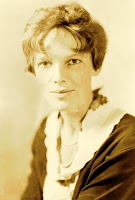
When deciding who to paint first, I went back to Amelia Earhart (You can read about her history here. ) I haven't done much watercolor painting in a long time and haven't drawn people since I was in college, so this is definitely a challenging, fun new project! 
For my next featured woman, I chose Julia Ward Howe

Born in 1819, the daughter of a well-to-do banker from New York City. At that time, the education of women was very limited. As a child she taught herself, reading from the library her brother sent from Europe during his travels. In 1843 she married Dr. Samuel Gridley Howe, a physician and reformer who founded the Perkins School for the Blind in Boston, Massachusetts. He frowned upon Julia's literary ambitions and forbade her from working outside of the home or being anything more than a traditional housewife. After 20 years of marriage, Julia confided in her diary: "I have never known my husband to approve any act of mine which I myself valued."

Despite her husband's rigid opinions, Julia became one of the most celebrated women in America. In 1861, she was inspired to write, "The Battle Hymn of the Republic" after she and her husband visited Washington D.C. While watching Union troops singing the song, "John Brown's Body" a friend urged her to write new words for the old tune. Her new song, Battle Hymn of the Republic lifted the hearts of many and transformed her into a permanent symbol of patriotism.

After the war, Julia focused her activities on pacifism and women's suffrage. In 1870, she was the first to proclaim Mother's Day. She was also a co-editor and writer for The Women's Journal, which lobbied for suffrage and human rights. After her husband's death in 1876, she founded the Association of American Women, a group which advocated for women's education. In addition to her reform work, she also wrote travel books, children's fiction and music.


Resources: Wikipedia, JuliaWardHowe.org, Remarkable American Women, Life Magazine, 1976.

I love reading stories of women who are strong enough to stay true to themselves despite living in a society where their efforts are strongly discouraged. The courage to rise up above the norm, accomplish great things that spark change in our world is in my opinion, inspiring.

Thursday, February 24, 2011

Sheroes: Lucille Ball


With February well under way, it's time for another Sheroes feature! Sheroes is a monthly feature where I share a little history on a woman (alive or dead) who's life I find aw-inspiring. (Click here to read about my last Sheroes post).

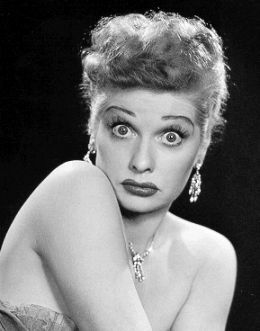
My shero this month is Lucille Ball. My boyfriend, James and I have recently started rewatching episodes of I Love Lucy (both of us hadn't watched the show in many years) and we've fallen head over heals for Lucille Ball ever since. She was an amazing actress and comedienne. For more than thirty years, she was one of the most recognized and loved entertainers in the world. She was in show business for 60 of her 77 years. She appeared in 74 movies and literally hundreds of TV shows.

While we all remember her from television, she worked in movies for over 15 years before I Love Lucy aired in 1951. She started her career as a fashion model in New York in 1929. (I had so much fun discovering old photos from Lucy's modeling career. She was so beautiful! And a blonde when she first started out!) In the mid-1930's she moved to Hollywood and began work in movies. By the end of the decade she appeared in 43 films and was known as the Queen of "B" movies.


1930's Lucy - Colorized
1944 Max Factor Ad Featuring Lucy
Lucy at the Wheel

Though she had the talent and charisma as a performer during that time, it wasn't until she played a part in the radio program, "My Favorite Husband" that her true genius appeared. "My Favorite Husband" was a situation comedy about a housewife who was always getting into trouble. After two successful years, Lucille Ball moved her radio show act to the new medium of television, bringing along her husband, Cuban band leader, Desi Arnaz, as her costar. Together they created the most popular television show of the 1950's- I Love Lucy.

The first episode aired on October 15, 1951 and for the next 25 years Lucille Ball virtually ruled the airwaves in a series of situation comedies designed to exploit her elastic expressions, slapstick abilities and distinct verbal talents (source).

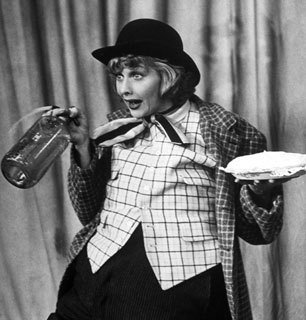
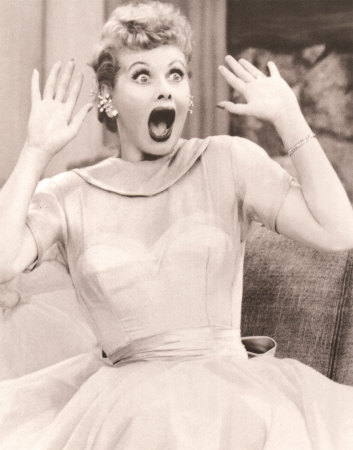
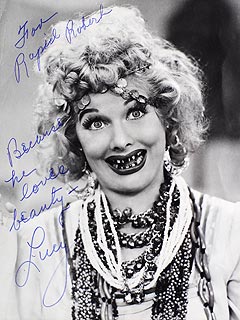
The genius herself once said, "I'm not funny. What I am is brave." I think above all, that describes Lucy best. No other actress has been able to be simultaneously drop dead gorgeous and insanely funny like Lucy was. I love looking through photo archives and finding beautiful photos (like those above) as well as her hilarious comedy characters (see below). She worked fearlessly throughout her career and became a star that was dearly loved by all.

"I would rather regret the things that I have done than the things that I have not." 
-Lucille Ball

"Once in his life, every man is entitled to fall madly in love with a gorgeous redhead."
-Lucille Ball
"The secret to staying young is to live honestly, eat slowly, and lie about your age."
-Lucille Ball
For all her impact upon the very nature of television, Ball is most vividly recalled as a series of black and white images. To remember Lucille Ball is to recall a profusion of universal images of magical mayhem--a losing battle with a candy conveyor belt, a flaming nose, a slippery vat of grapes--images which, contrary to most American situation comedy, transcend nationalities and generations, in an absolute paradigm of side-splitting laughter (source).

Sources: 

Also checkout my boyfriend, James' new blog:

Thursday, January 13, 2011

Sheroes: Amelia Earhart

Introducing yet another feature on my blog called, Sheroes, a term I like to use for my favorite female heroes. Every month I will feature a woman (living or dead) who's life and story I find aw-inspiring.

Because tuesday was Amelia Earhart Day, I thought she would be the perfect Sheroe to feature first. We all know her famous story. She was a noted American aviation pioneer and author. She set many records and wrote many best-selling books about her flying adventures. She was the first woman to receive the U.S. Distinguished Flying Cross, awarded for becoming the first aviatrix to fly solo across the Atlantic Ocean. During an attempt to make a round-the-world flight in 1937, she disappeared over the central Pacific Ocean near Howland Island.

Not only was her passion and accomplishments in aviation influential, but she also worked hard to encourage more women to do the same. She helped form The Ninety-Nines, an organization for female pilots and joined the faculty of the world-famous Purdue University aviation department to counsel women on careers and help inspire others with her love for aviation. She was a member of the National Woman's Party, and also an early supporter of the Equal Rights Amendment.

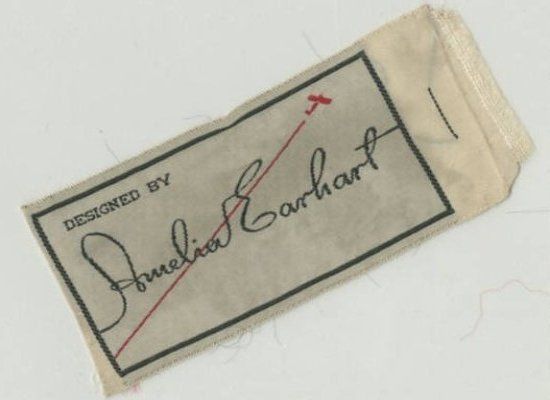
One thing that I was excited to learn about Amelia was that she was also one of the first American celebrities to endorse and market a women's fashion line! She learned to sew at a very young age and to finance her flying adventures she created, "Amelia Earhart Fashions" in 1934. Her line was sold at Macy's in New York and Marshall's in Chicago. I personally think it's amazing that she accomplished so much and as a female celebrity of the 1930's, was so good at creating an promoting her own brand.

She designed a women's flying suit for The Ninety-Nines and when she was off the runway she appeared in fashion spreads of Vogue Magazine and was also an editor of Cosmopolitan. She stayed actively involved in her fashion line and even created her line's samples using her own sewing machine and dress form with the help of a seamstress in New York.

Now, I have not seen the new movie, Amelia with Hillary Swank. I just added it to my netflix. I can't wait!

Resources:
Amelia Earhart's Fashion Line: Found At Last By Mary Hall, Huffington Post, 2009
Flights of Fashion: How Amelia Earhart Became America's First Celebrity Designer By Gioia Diliberto, Huffington Post, 2009
Wikipedia

Tuesday, February 2, 2010

Artist of the Day

Late last night, when I should have been in bed, but was instead sitting at my computer skimming through my Reader, I found the work of Sister Corita. Sister Corita Kent was an artist, nun (until 1968), activist and teacher. And she was one of the most politically radical, socially progressive printmakers of the 20th century. Her work is very beautiful and captivating. Read more about her life and work here.


www.corita.org
Related Posts with Thumbnails